
Blog · Korean culture
Korean bakery stories
Where Korean salt bread really comes from: Japan's shio pan vs the Korean version
Salt bread is Japanese. A small bakery called Pan Maison in Yawatahama, Ehime came up with shio pan (塩パン) around 2003 and started selling it in 2004, and it went viral in Korea from about mid-2021 on social media. It is not a laminated croissant dough. Each roll is wrapped around a stick of butter, so the butter melts out in the oven, leaving a hollow center and a base that fries in the pooled butter. Japan kept the idea simple, while many Korean bakeries pile on fillings and toppings.
Which country invented salt bread?
Japan did. The Japanese name is shio pan (塩パン), and the bakery's own site, a Japan Chamber of Commerce article and a Shikoku Electric feature all tell the same story. It was made by Mitoshi Hirata, the owner of Pan Maison (パン・メゾン) in Yawatahama, Ehime.
Sources differ by a year on the date. They agree that he came up with it around 2003 and put it on sale the following year, so "conceived in 2003, sold from 2004" is the safe way to write it. English Wikipedia and a few foreign outlets say around 2014, which does not match the Japanese primary sources.
It started with summer. Bread sold poorly in the heat, so he looked for something people would still want on a hot day. A salted French loaf at the shop where his son worked gave him the hint, and fish-market workers and students who tried the prototype liked it enough to turn it into a product.
How shio pan is made
The dough is close to a soft baguette dough, rolled around butter and baked. The shop says it found by accident that when ten rolls go on one tray, the melted butter pools underneath and fries the base. That gives three textures in one roll: a crisp crust, a crunchy bottom and a chewy middle.
Ordinary salt tends to melt away in the oven and lose its taste. Pan Maison says it breaks rock salt with a hammer so the grains survive on top, though it has never named the salt.
The recipe was shared with the industry and could not be trademarked, which is why bakeries all over Japan were able to sell it under the same name.
When it blew up in Korea
Korean salt bread took off from around mid-2021, according to a July 2023 Chosun Ilbo article and a February 2026 piece in Eater. Nothing I could confirm shows it arriving in Korea earlier than that.
A Kyunghyang Shinmun column sums up the split in one line: Japan empties, Korea layers. Japan leaves the roll as a plain butter bun, and Korea went the other way, adding fillings and toppings one step at a time.
| Japanese shio pan | Korean salt bread | |
|---|---|---|
| Name | 塩パン (shio pan) | 소금빵 (sogeum-ppang), usually sold as salt bread |
| Origin | Pan Maison, Ehime, 2003 to 2004 | Arrived from Japan, popular since mid-2021 |
| Structure | One butter stick rolled in dough, hollow inside | Same base, with fillings and toppings added at many shops |
| Price | Around 100 yen at the original shop (about 95 yen) | Roughly 2,000 to 7,000 won |
Salt bread vs croissant
The shapes look alike, so many people call it a croissant with salt on top. A croissant, though, gets its layers from folding butter into the dough and rolling it out again and again. Salt bread skips the folding and just rolls each piece of dough around a butter stick, so the layers form for entirely different reasons.
That is also why it is hollow. In the oven the butter melts and runs out of the dough, leaving a gap, and the remaining dough fries in the butter that pools on the tray. A bigger hole does not mean a better roll, since the size depends on each shop's recipe.
English sources contrast the honeycomb crumb of a croissant with the butter hole of salt bread. English Wikipedia has a short entry under the name Japanese buttery roll, and US outlets describe it as made in Japan and popularized by Korea.
How the two breads differ in the game's dex
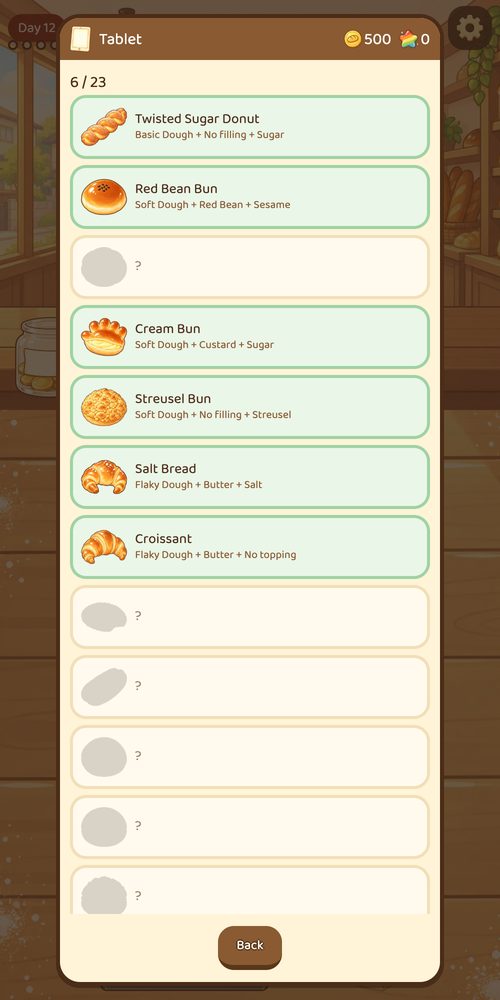
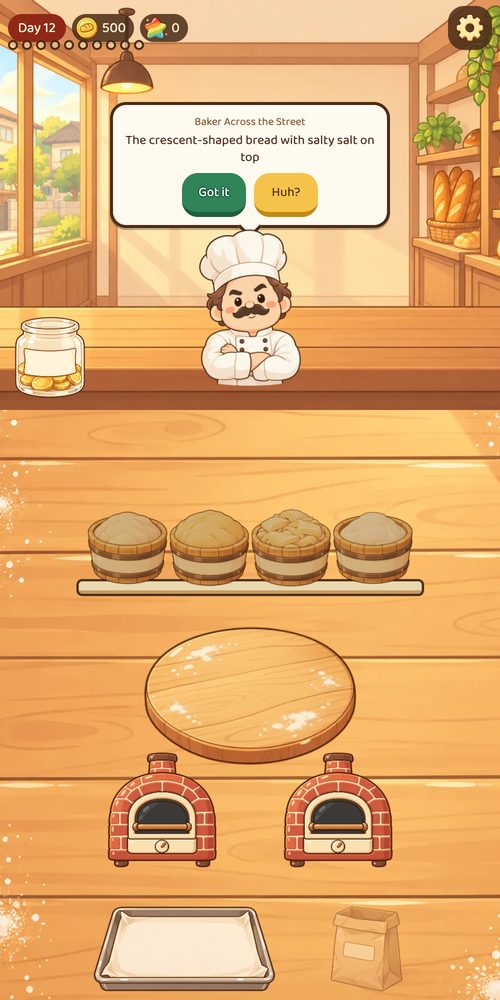
Chichi's Baking: Cooking Games is a game where customers describe a bread vaguely and you build it from three slots: dough, filling and topping. The dex holds 23 breads, and salt bread unlocks on day 7. The customer only says, "A crescent-shaped bread with salty salt on top."
In the game, the salt bread recipe is layered dough, butter and a salt topping. The croissant right below it is layered dough, butter and no topping, so the two differ by a single topping slot. That was chosen to keep the game rules simple and does not match the real structure described above. Making salt bread in the game shows you why that topping slot matters.
Calories and the English name
A roundup of Korean bakery labels lists a regular 60 to 65 g roll at roughly 210 to 220 kcal. Larger rolls of 75 g or more, or ones made with rice flour, climb to 340 to 370 kcal. Treat 200 to 350 kcal as the range, depending on size and butter. These figures come from a blog that collected company labels, so check the nutrition label on the package for the exact number.
In English, salt bread is the most common name. Some writers add the Korean romanization, sogeum-ppang, and shio pan is the Japanese name.
FAQ
Where did Korean salt bread originate?
In Japan. Shio pan (塩パン) was conceived around 2003 and sold from 2004 by a bakery called Pan Maison in Yawatahama, Ehime. It became popular in Korea on social media from about mid-2021.
Why is salt bread hollow inside?
Because the dough is rolled around butter. The butter melts and runs out of the dough in the oven, leaving a gap. The size of the hole depends on the shop's recipe, not on quality.
Is salt bread the same as a croissant?
No. A croissant gets its layers from folding butter into the dough and rolling it out several times. Salt bread is not folded; a stick of butter is simply rolled up inside.
What do you call Korean salt bread in English?
Salt bread is the most common name. Some add the Korean romanization, sogeum-ppang, and in Japan it is called shio pan.
How many calories are in Korean salt bread?
A regular 60 to 65 g roll is roughly 210 to 220 kcal, and larger ones can reach 340 kcal or more. The nutrition label on the package is the most accurate.
More from the blog
 ComparisonWe ran 9 Android ASMR games on a real phoneWe installed nine ASMR games on a Samsung Galaxy Z Flip5 and relaunched each in airplane mode. Install size, first screen and whether an ad blocks the game, checked on 20 November 2026.
 ComparisonOnsen and bathhouse games: 8 compared by what the store pages sayOnsen and bathhouse games from Steam, Google Play and the App Store in one table: price, rating, idle or not, Korean and Japanese support, plus the weak spots of our own game.
 ComparisonIdle tycoon games that work offline: 8 picks sorted by store labelsWhich idle tycoon games work offline? Google Play tag, store wording, list price and ads in one table, plus our own game's weak spots.
 Games likeFinished Kairosoft? 14 games to play next, sorted by what you lovedIf you have played through Kairosoft, here are 14 games sorted into four flavors: short grow-it sessions, running a shop, watching residents live, and layout puzzles. Steam list prices, review scores and UI languages checked by hand.