
Blog · Guide
Beginner guide
Internet Cafe Tycoon, first 30 minutes: what to buy and when the money starts to stack
Internet Cafe Tycoon starts you with ₩5,000 and six used PCs. We played a fresh save through 15 in-game days, about 30 real minutes, and this is how it went. The first PC is bought around minute 3 for ₩34,033. Neighborhood Café (stage 2) opens between minutes 8 and 10, once total revenue passes ₩130,000. Downtown Café (stage 3) opens at minutes 27 to 29, past ₩490,000. The costliest beginner mistake is saving money instead of spending it: with the same setup, daily sales ran 39% lower and the run never reached stage 3. Hiring a part-timer was not essential in the first 30 minutes.
What you start with
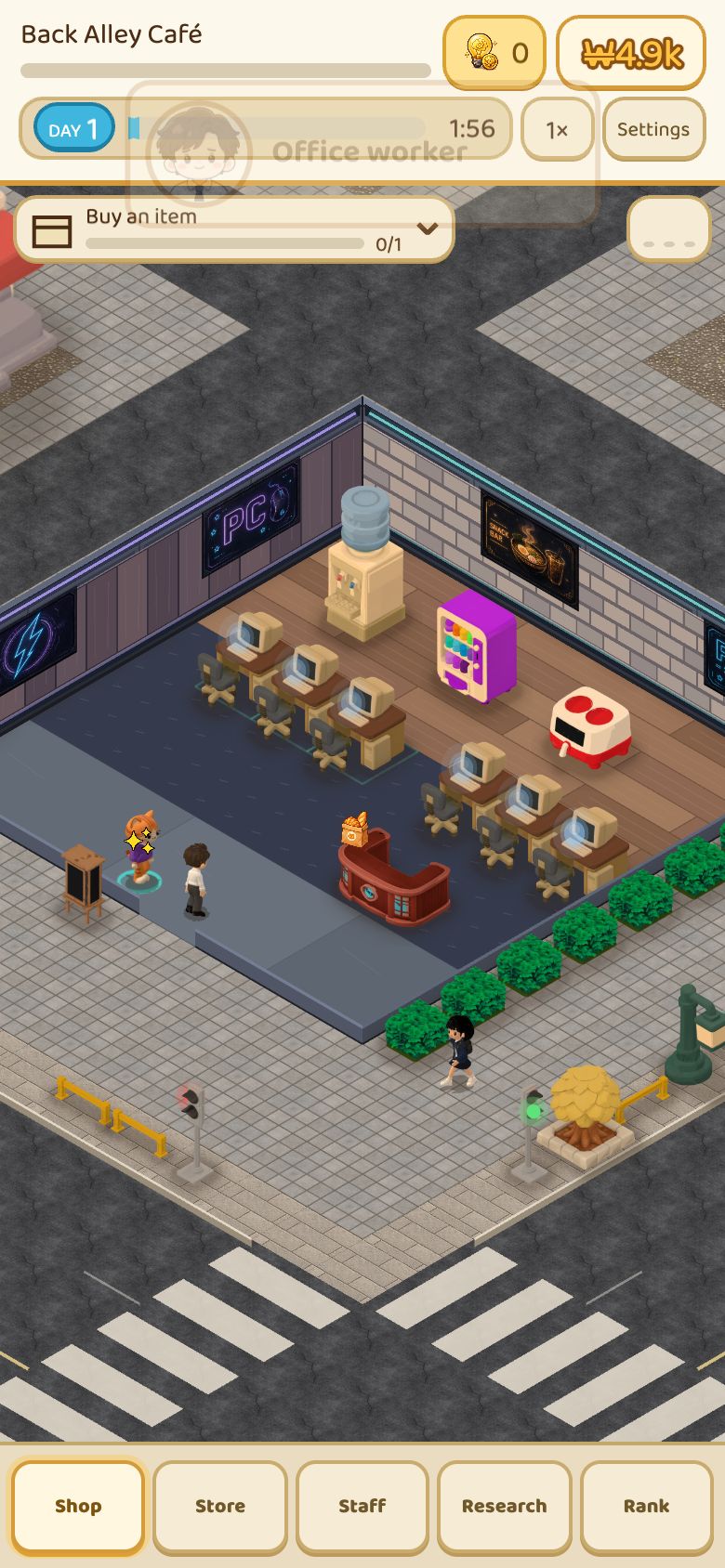
On a fresh save the cafe has six used PCs, a counter, a water cooler, a drink machine and a ramen station, one of each. You have ₩5,000 and the only worker is owner Chichi. One part-timer slot is open and the other four are locked.
The first goal is Buy an item, and it pays ₩2,000. Two guests walk in as soon as you open. A day lasts 2 real minutes, and while the Store or Staff screen is open the clock stops, so game time is real time. That is why 15 in-game days come to roughly 30 real minutes.
The room starts at 8×8 tiles, and stage 1 lets you place up to 8 PCs.
The 30-minute timeline
This is a log of the English build played for 15 days on a fresh save. Minutes follow the game clock, and rows with a range come from several runs. A bot chose what to buy, so a person may be a minute or two faster. The screens round prices (₩34k), and the table gives the exact amounts.
| Time | What happens | Numbers |
|---|---|---|
| 0 min | Shop opens. Goal: Buy an item | ₩5,000 on hand, 6 PCs |
| About 0.3 min | First guest sits down and the first payment lands | First payment ₩157 |
| Around 1 min | First dirty seat. The part-timer application can be opened | Hiring cost ₩10,800, daily wage ₩1,800 |
| 2 min | Day 1 wrap-up card | 9 guests left because no seat was free |
| Around 3 min | First purchase. When cash reaches the PC price, a hint to place one more PC appears | Used PC ₩34,033 |
| 5 to 7 min | Second PC and the lockers | PC ₩37,845, lockers ₩30,000 |
| 8 to 10 min | First PC upgrade. Past ₩130,000 total revenue, stage 2 Neighborhood Café opens | PC Lv 2 ₩32,400, threshold ₩130,000 |
| 27 to 29 min | Past ₩490,000 total revenue, stage 3 Downtown Café opens and a second-branch window pops up | Threshold ₩490,000 |
| 30 min | Day 15 closes | About ₩510,000 total, 8 PCs, 1 part-timer, about ₩40,000 sales a day |
Buy a PC first
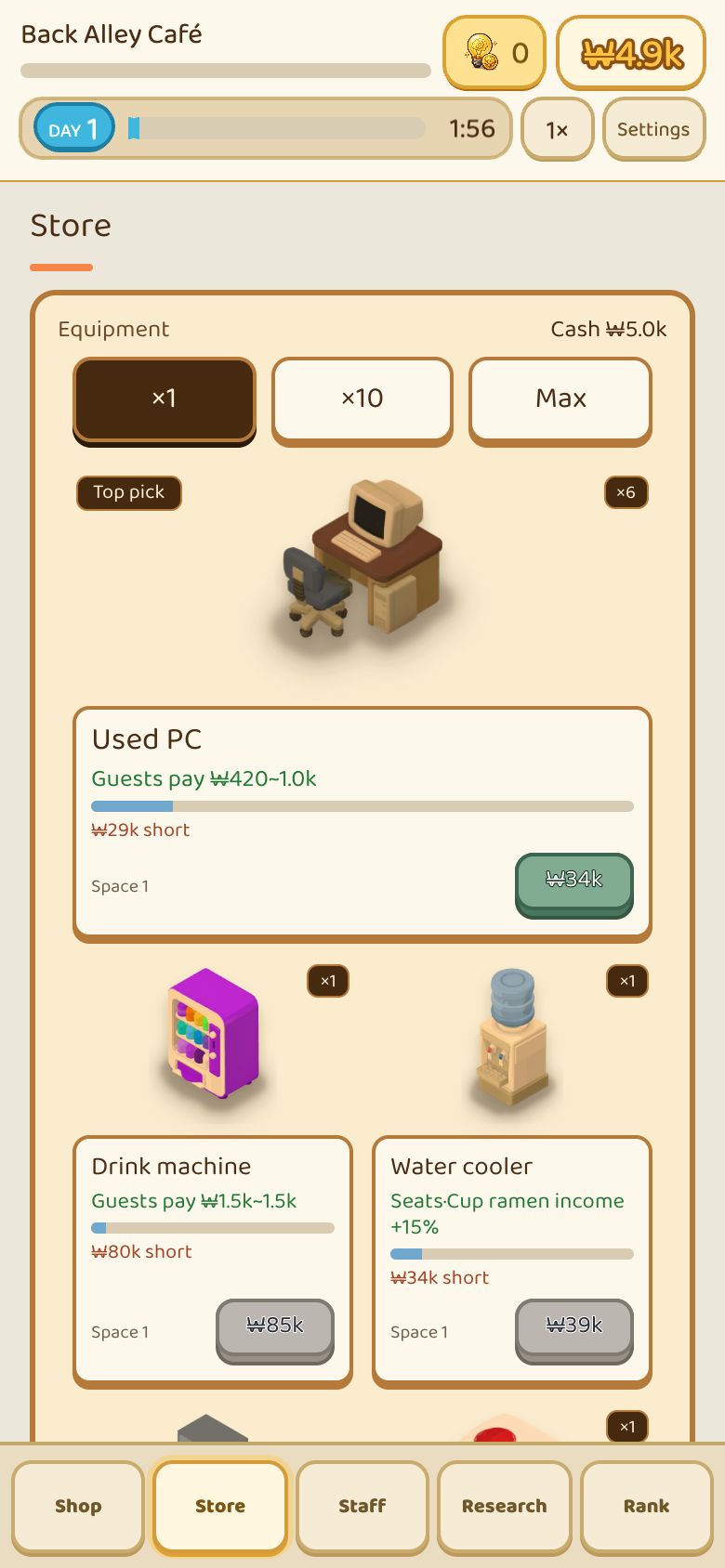
When the first money comes in, open the Store and place a used PC. Each PC you buy costs about 11% more than the last (×1.112), and the store buys one at a time by default (×1). The first costs ₩34,033, so the second is ₩37,845. Buying early means buying cheap.
In placement mode, setting a piece next to an existing fixture shows a "close together" mark (×1.08). Pick a spot and confirm with the place button.
We also ran the same money on a water cooler and a drink machine instead. That run was capped at 7 seats because it skipped the PC, and its average sales on days 9 to 10 were about ₩21,000. The base run was around ₩40,000 for the same days, so this one came in roughly 48% lower.
Saving cash actually slows you down
The most common mistake is holding on to money to buy something better. In a run where we barely spent for 15 days, average daily sales were ₩26,500, below the base run's ₩32,800. Looking only at days 9 to 12, it was ₩24,300 against ₩40,200, a 39% gap.
With no new seats, guests who gave up waiting rose from 71 to 104, up 46%. On day 15 there was ₩424,026 sitting unused, but total revenue was only about ₩396,000, short of the ₩490,000 stage 3 mark.
This cafe grows when you put earnings back into seats. In the first 30 minutes, "buy as soon as you can afford it" is close to the right answer.
A part-timer wasn't necessary in the first 30 minutes
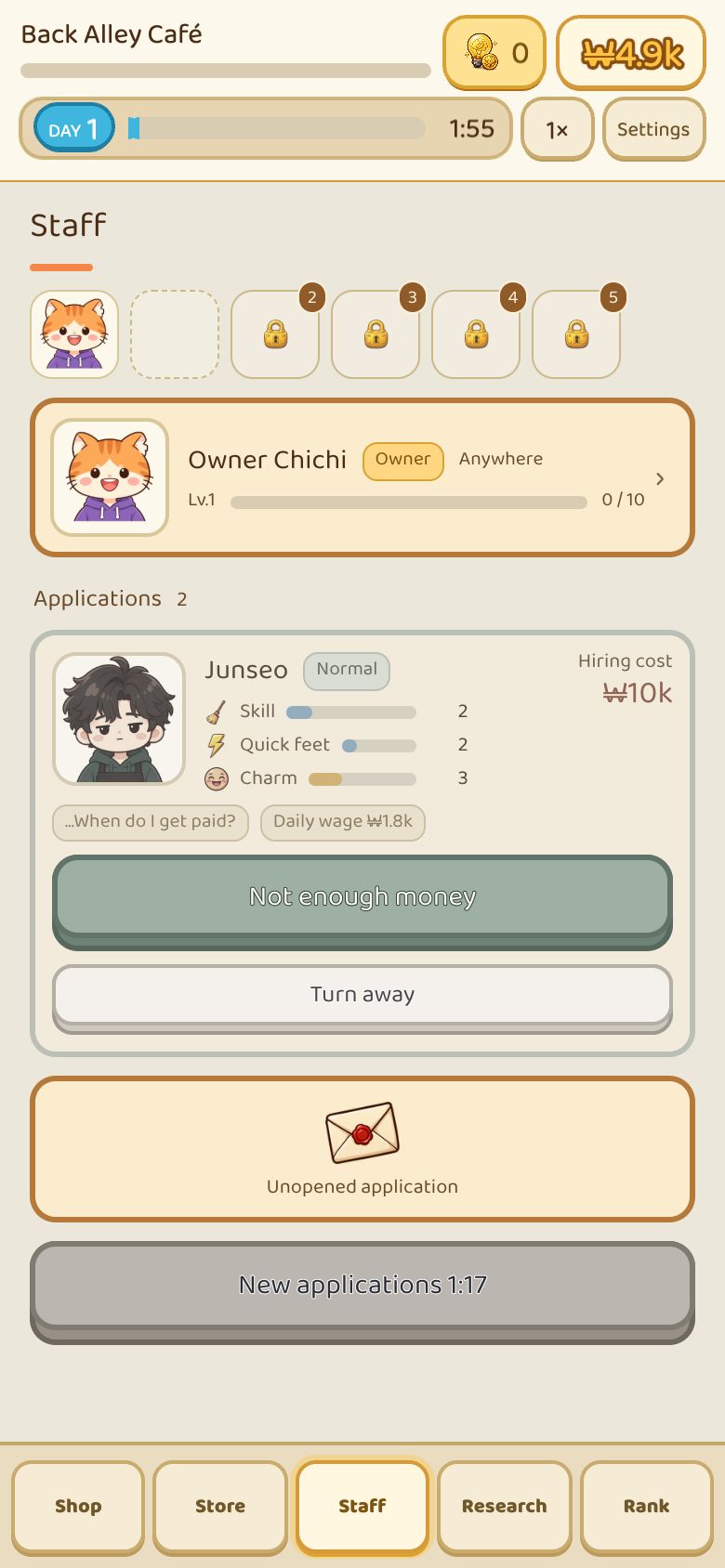
The part-timer slot is open from the start, which makes it tempting. Junseo costs ₩10,800 to hire and ₩1,800 a day in wages. The wage goes out every day, and in one run cash dipped to −₩1,595.
We also ran 11 days without hiring anyone. Average daily sales were ₩33,300, about the same as the base run's ₩32,800, and the owner handled the cleaning and the ramen alone. So in this stretch, skipping the hiring cost and the wage did not hurt.
These are single runs, and daily sales swing by about ±15%. Read it as "PCs and lockers come first in the first 30 minutes," not as "you never need staff."
When dirty seats and broken PCs pile up
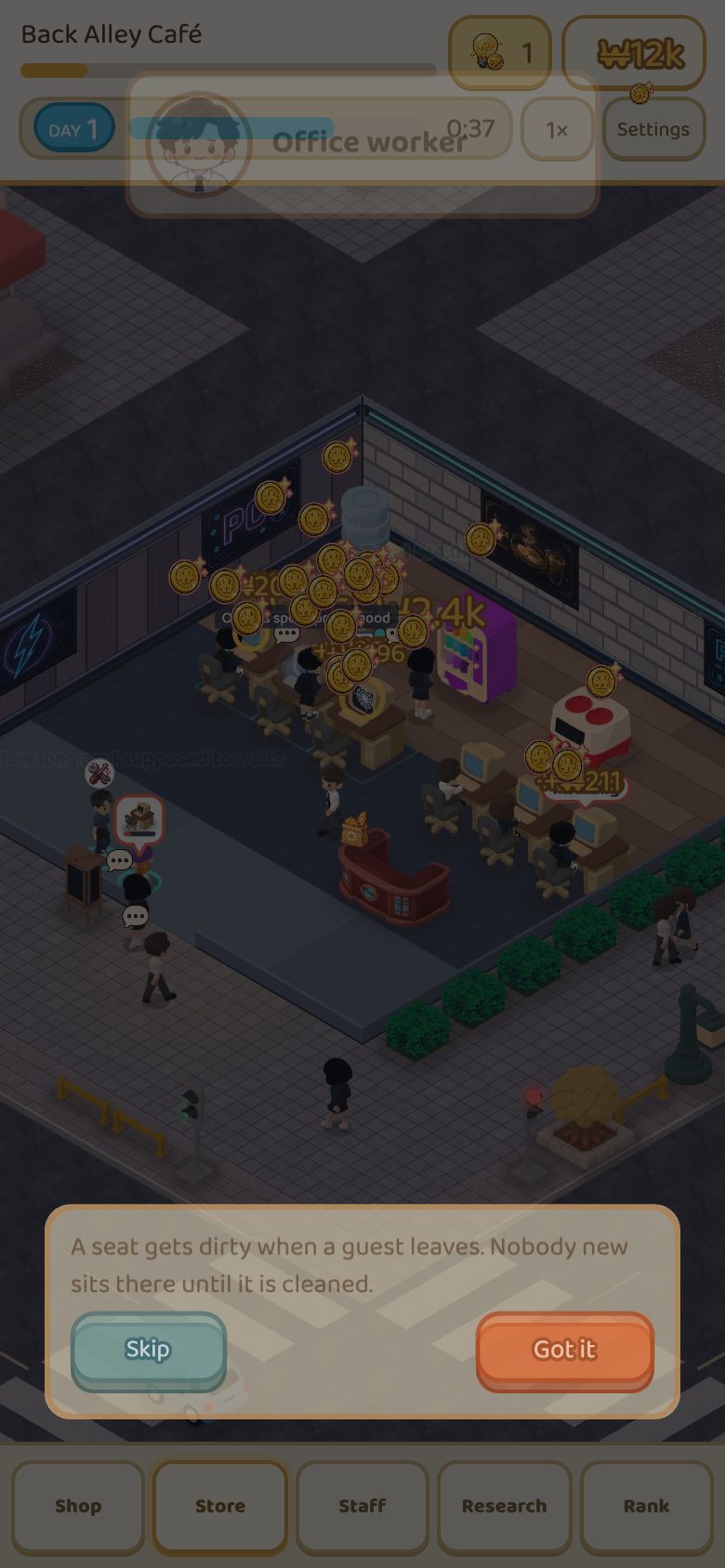
A seat gets dirty after a guest leaves, and PCs break now and then. Until a seat is cleaned or a PC is fixed, no new guest can use it. Counting over 15 days, there were 1.1 at a time on average and 2 at most. Having a part-timer made no difference.
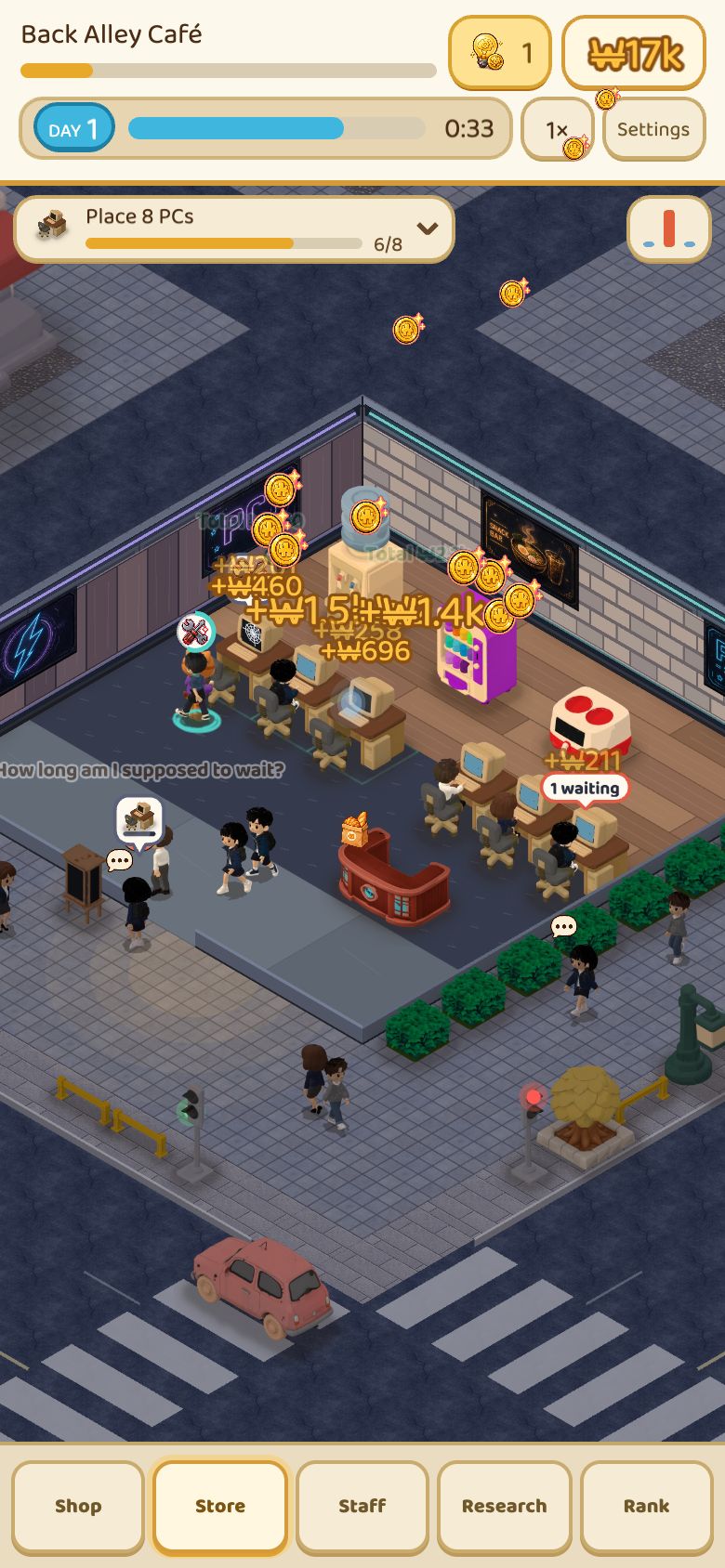
When you see the broom or the broken-PC icon, deal with that seat first. Blocked seats lengthen the line, and an angry face shows above a guest's head. Over 15 days about 6 guests a day left because no seat was free.
The one thing to read on the wrap-up card
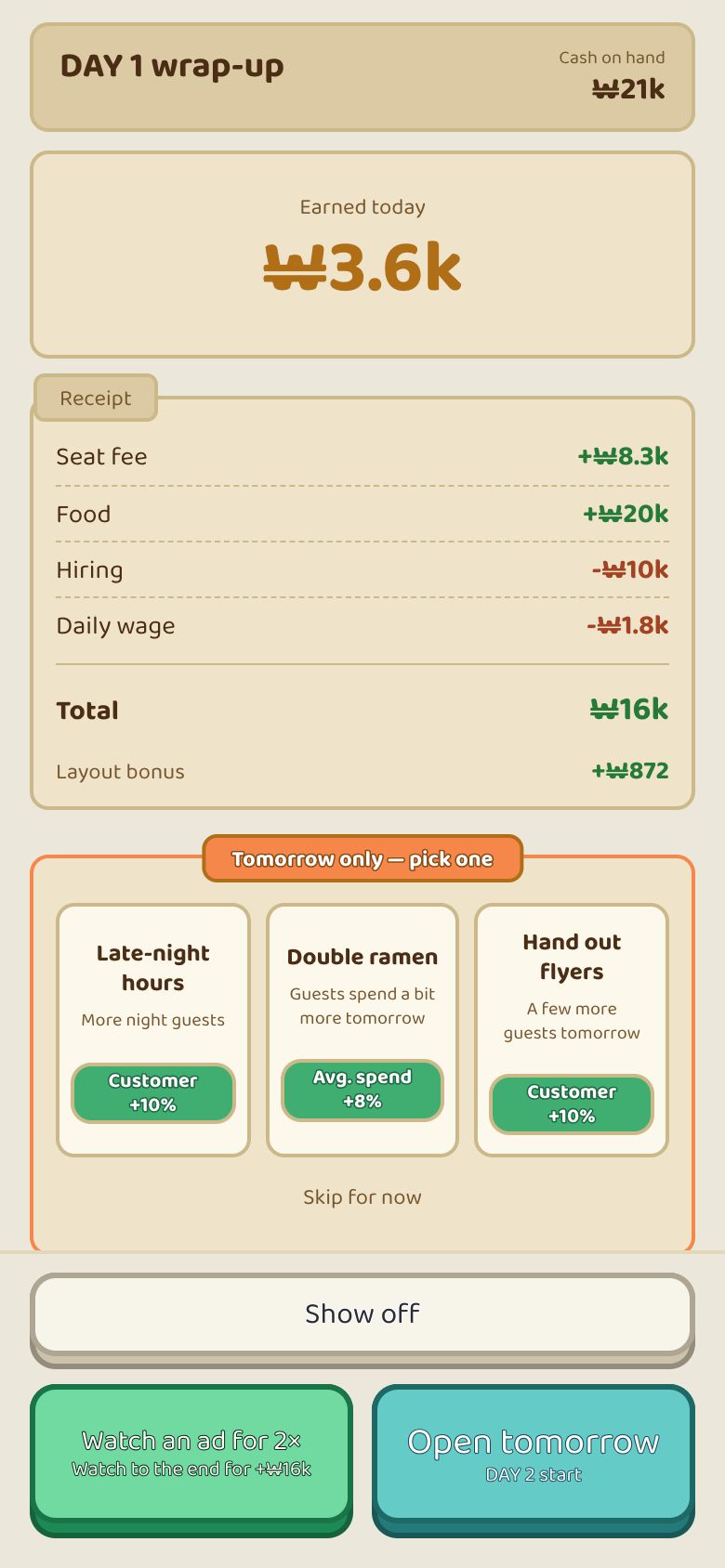
When the day ends, a wrap-up card appears. Seat fee, Food, Hiring and Daily wage are listed like a receipt, and Earned today is net profit after spending. On days when you upgrade or hire, net profit can be as low as ₩380, and in the English-build run it even showed a negative number on one day. That is not a bug.
At the bottom, a "Tomorrow only, pick one" panel offers three choices: Late-night hours (customers +10%), Double ramen (average spend +8%) or Hand out flyers (customers +10%). You can skip it. In this run we took one of the +10% options.
What the cafe looks like after 30 minutes
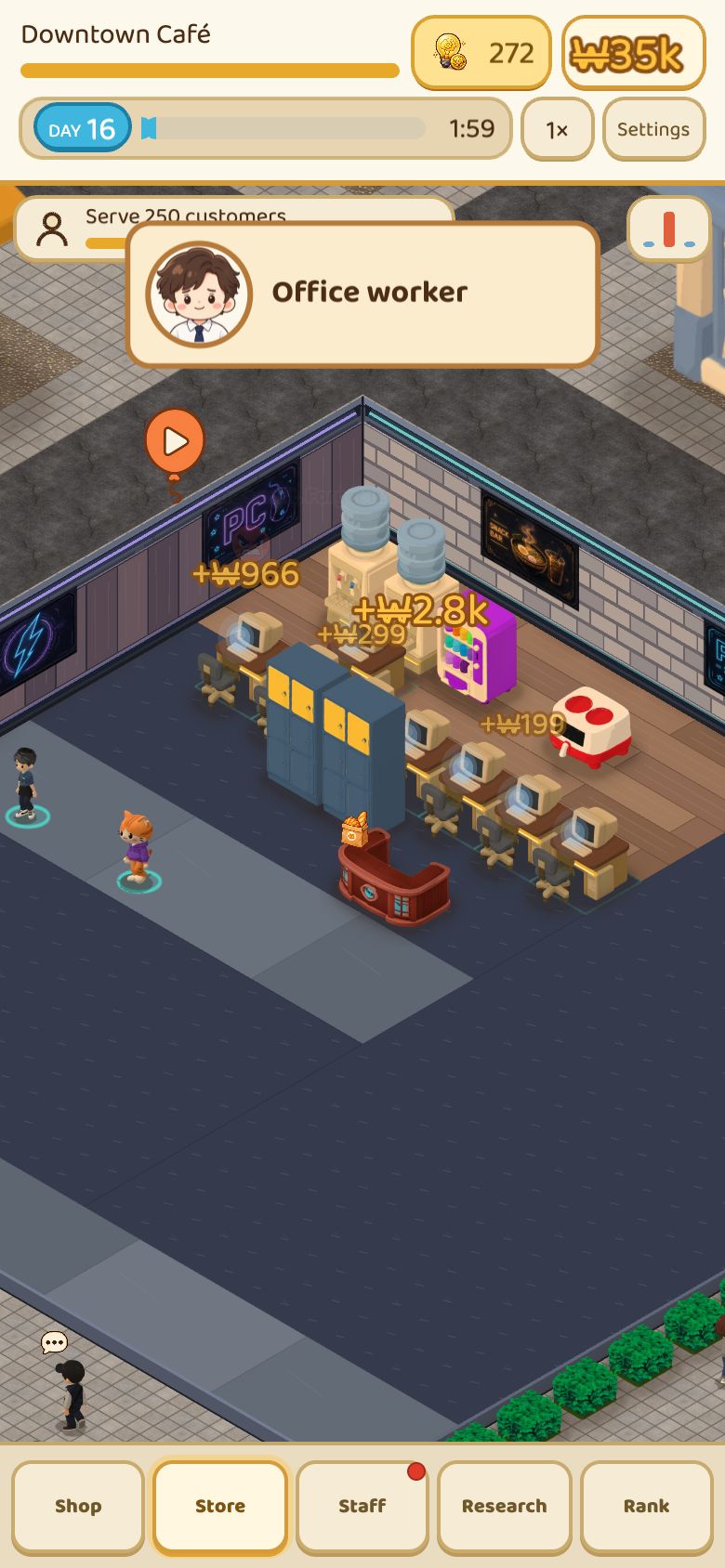
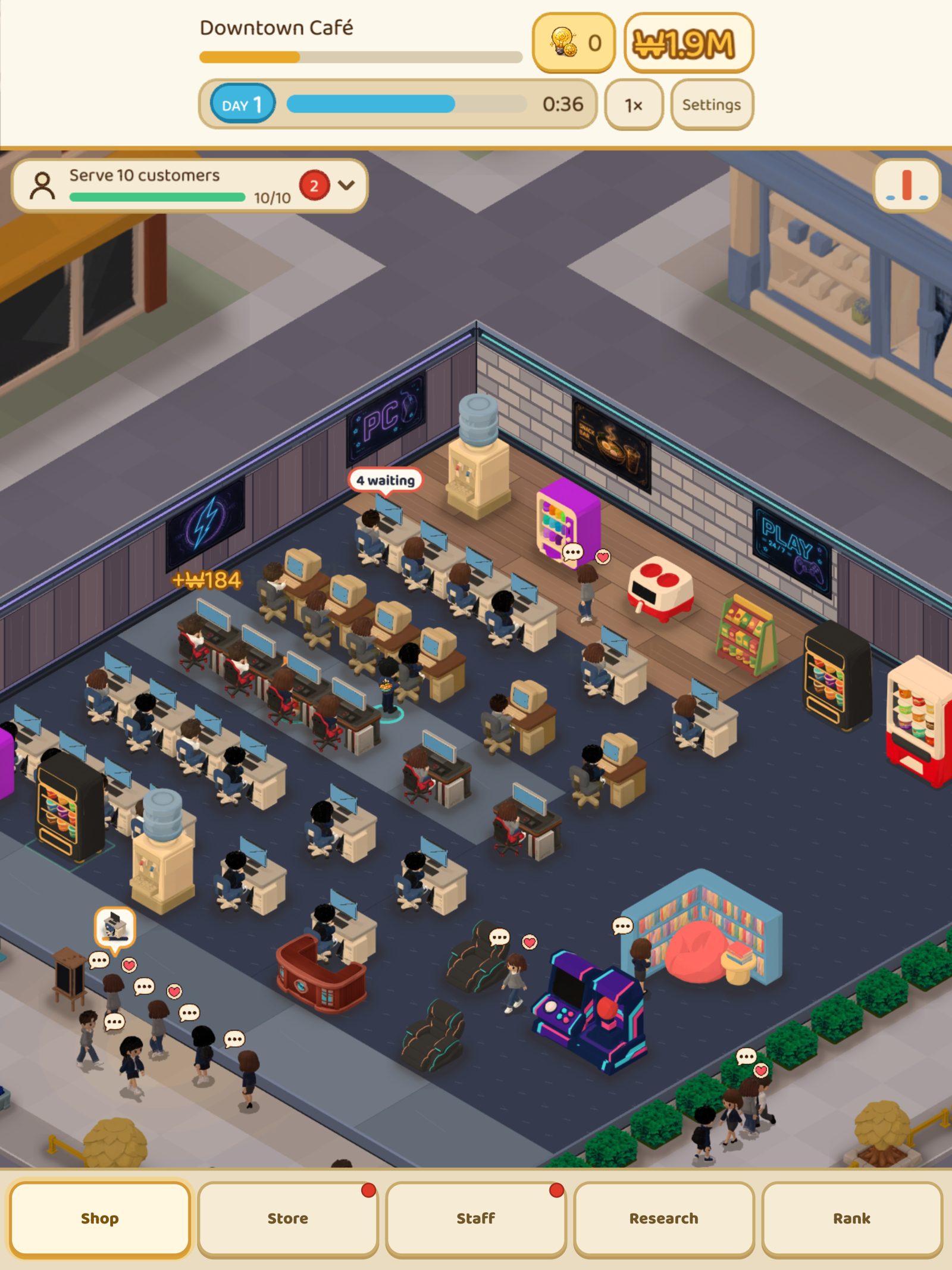
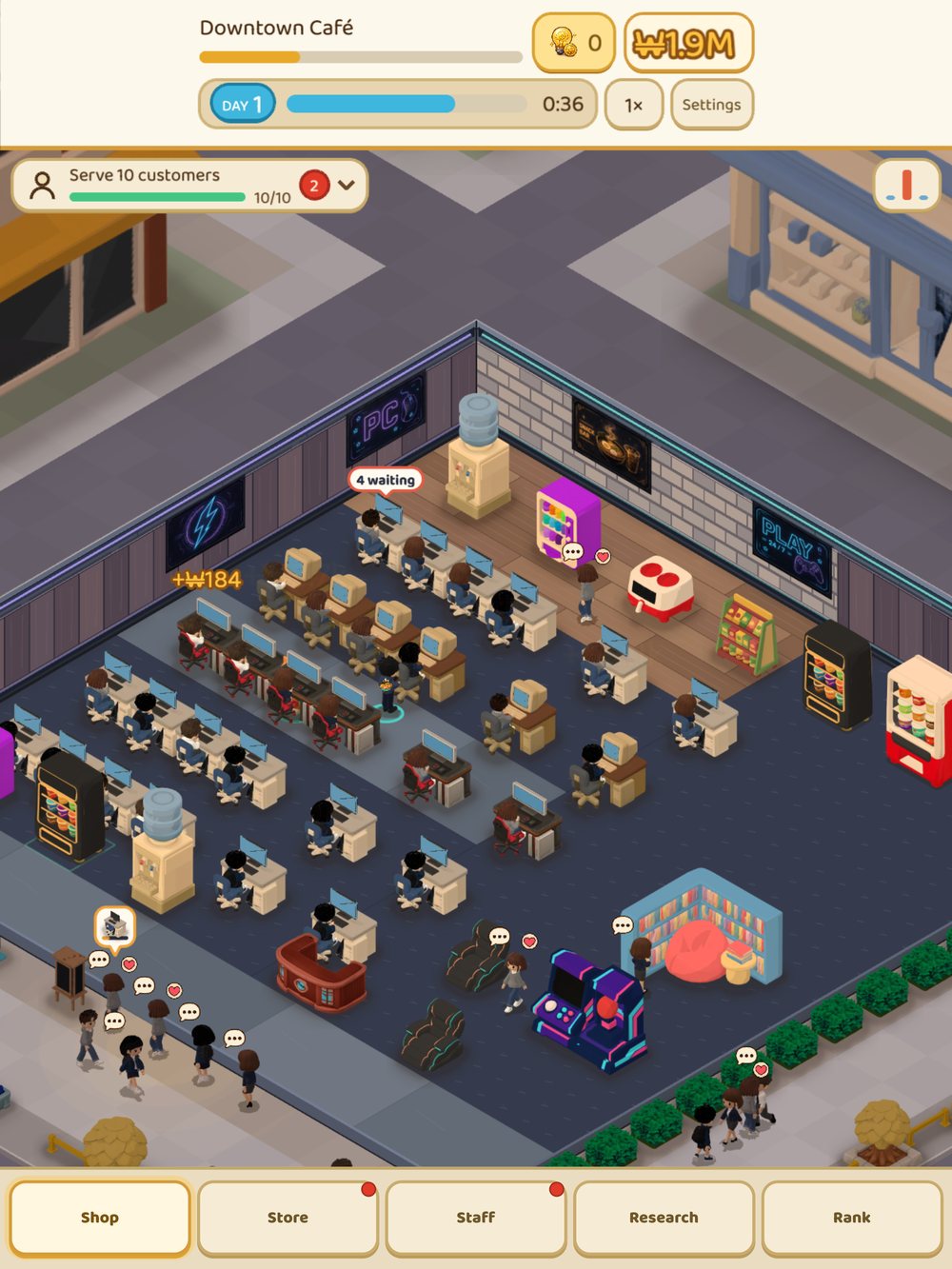
At day 15 the cafe is a stage 3 Downtown Café and the room has grown to 15×15 tiles. This run only placed 8 PCs, so a lot of floor looks empty. That is room a person could fill.
Daily sales were about ₩40,000 and total revenue about ₩510,000. We also ran a version that saved up and bought only the recommended fixtures, and total revenue came out nearly the same, ₩513,000 against ₩510,000. Whether you spend on PC upgrades or fixtures, 30 minutes shows little difference.
First 30 minutes checklist
Boiled down to an order, the log above looks like this.
- If your cash reaches a PC's price in the first 3 minutes, place a used PC right away.
- Tap dirty seats and broken-PC icons as soon as you see them.
- Don't sit on cash. Buy when you can, and put earnings back into seats.
- A part-timer can wait until after PCs and lockers.
- A low net profit on the wrap-up card is normal on an upgrade day.
- Watch only two targets: ₩130,000 total revenue (stage 2) and ₩490,000 (stage 3).
How we measured this, and where it falls short
We ran the game headless from a fresh save and fast-forwarded the game loop to fill 15 days. A bot, not a person, chose what to buy, and we ran the same setup several times to give ranges. Daily sales move about ±15% from run to run, so read the comparisons above only as "this one is clearly better." The no-part-timer run covers 11 days and the drink-machine-first run covers 10.
The game has weak spots too. The 3 minutes before the first PC is spent waiting for money, so your hands are idle. You reach stage 3 within 30 minutes, but after that the thresholds jump: ₩1,800,000 for stage 4 and ₩10,000,000 for stage 5. It is a new release, so it has no store ratings yet.
FAQ
What is the first goal in Internet Cafe Tycoon?
Buy an item. It pays ₩2,000 and is done once you buy a used PC in the Store and place it. The ₩5,000 you start with is not enough, so you wait about 3 minutes for guests to pay up to the PC's price.
Should I hire a part-timer first?
It wasn't necessary in the first 30 minutes. A run with no part-timer had average daily sales close to the base run. Spending the ₩10,800 hiring cost and ₩1,800 daily wage on PCs and lockers first is the better call. These are single runs, so daily sales swing by about ±15%.
When do stage 2 and stage 3 open?
Stage 2, Neighborhood Café, opens at ₩130,000 total revenue, and stage 3, Downtown Café, at ₩490,000. In our runs that was minutes 8 to 10 and minutes 27 to 29. The next thresholds are ₩1,800,000, ₩10,000,000 and ₩150,000,000.
Isn't it better to save money and spend it all at once?
Not in the first 30 minutes. A run that barely spent for 15 days made ₩24,300 a day on days 9 to 12 against ₩40,200 for the base run, 39% lower, and guests who left without a seat rose from 71 to 104.
More from the blog
 ComparisonOnsen and bathhouse games: 8 compared by what the store pages sayOnsen and bathhouse games from Steam, Google Play and the App Store in one table: price, rating, idle or not, Korean and Japanese support, plus the weak spots of our own game.
 ComparisonIdle tycoon games that work offline: 8 picks sorted by store labelsWhich idle tycoon games work offline? Google Play tag, store wording, list price and ads in one table, plus our own game's weak spots.
 Games likeFinished Kairosoft? 14 games to play next, sorted by what you lovedIf you have played through Kairosoft, here are 14 games sorted into four flavors: short grow-it sessions, running a shop, watching residents live, and layout puzzles. Steam list prices, review scores and UI languages checked by hand.
 Games likeGames like Game Dev Story: 7 Kairosoft alternatives worth playing nextGames like Game Dev Story and Kairosoft alternatives on Steam, iOS and Android, with price, ratings and language support in one table.