
Blog · Korean culture
Korean street snacks, sorted
Hotteok, bungeoppang and yakgwa: how many of them are actually bread?
The Basic Korean Dictionary defines bread as "food made by kneading wheat flour, fermenting it, and then steaming or baking it." By that measure, hotteok comes closest to bread because its dough is fermented with yeast. Bungeoppang is baked without fermentation, which makes it a pulppang (batter-cake) that happens to be called bread, and yakgwa, dough fried in oil and soaked in honey, is a traditional hangwa confection. Below I split the three by dough, cooking method and origin, and I also show how they ended up in a bakery game I made.
First, what counts as bread in Korean?
The Basic Korean Dictionary from the National Institute of Korean Language defines bread (ppang) as "food made by kneading wheat flour, fermenting it, and then steaming or baking it." That gives three conditions. It has to be a wheat-flour dough, it has to be fermented, and it has to be steamed or baked.
Hold the three snacks up to that ruler and they land in different places. Still, a dictionary is only a dictionary, and the range of things people call ppang in everyday Korean is far wider. So below I judge each one by the dictionary, and I also note how its name came to stick.
| Snack | Dough | How it's cooked | Bread by the dictionary? | Category |
|---|---|---|---|---|
| Hotteok | Yeast-fermented dough | Pan-fried on a greased griddle | Fermented, yes; "baked or steamed" is a gray area | Street snack (the name says tteok, rice cake) |
| Bungeoppang | Unfermented batter | Poured into a mold and baked | No fermentation, so strictly no | Pulppang (batter cake) |
| Yakgwa | Flour + honey + sesame oil dough | Fried in oil, then soaked in honey | No | Yumilgwa (hangwa confection) |
Hotteok: a yeast dough makes it the most bread-like of the three
Today's street hotteok is a yeast-risen dough wrapped around a brown sugar filling and pressed flat on a griddle. English Wikipedia and recipe sites all describe it as a yeast-fermented dough. That checks the fermentation box.
As for how it arrived, the Encyclopedia of Korean Culture says it came with Chinese migrants in the 1880s. There was a Chinese bakery called Pusing in Seoul in 1889, and by 1930 there were reportedly 1,139 Chinese-run hotteok shops across the country. It was first baked in a clay oven, and the Encyclopedia of Korean Folk Culture says the pan-frying method of today is "thought to" date from the 1970s, after cooking oil became common. Keep in mind that this part is an estimate.
The "ho" (胡) in the name has more than one explanation. The folk culture encyclopedia calls the idea that it means a rice cake sold by Qing Chinese a folk etymology, and explains that ho referred to the western regions and Central Asia. When the snack arrived and where its name comes from are two separate questions.
Bungeoppang: by the dictionary it's a pulppang, so strictly no
The Encyclopedia of Korean Folk Culture writes that bungeoppang batter has "no fermentation step." Soft cake flour is mixed with water, poured into the mold and filled with sweet red bean paste. The Encyclopedia of Korean Culture also files it under pulppang, a batter of flour, sugar and baking soda, which it classes as a bread-type food. Pulppang is the family where something like obangtteok can be called tteok but looks like bread.
The most widely repeated story says taiyaki began at Naniwaya in Tokyo in 1909. That year rests on an account from the shop's own side, so it is safer to call it "the 1909 story," and Namuwiki gives a different date, the late 19th century. The molds reached Korea in the 1930s, under Japanese colonial rule, and no record shows exactly when the first one arrived. Bungeoppang became a common street sight only after American aid flour spread in the 1950s and 60s.
Some posts say recipes vary from stall to stall and that some vendors use yeast or baking powder. For this post I went only by the basic version the dictionary and encyclopedias describe.
Yakgwa: a honey cookie handed down since the Goryeo era, and no bread
The Encyclopedia of Korean Culture defines yakgwa as a yumilgwa made by kneading wheat flour with honey and sesame oil, pressing it into a yakgwa mold and frying it in vegetable oil. Kneading, molding, frying and then jeupcheong, soaking in honey or rice syrup, all count as one process. There is no fermentation and no baking.
In the Goryeo period it was stacked high on offering tables at Buddhist events such as Yeondeunghoe and Palgwanhoe. The folk culture encyclopedia cites the Goryeosa, which records that yumilgwa won a reputation at Yuan court banquets and came to be called "Goryeo cake" in Mongolia. Another trait of this cookie is that overworking the dough builds up gluten and makes it hard.
In autumn 2026, convenience store mini yakgwa were the talk of the town, and a mid-November article reported that Naver search volume had dropped below 10% of its peak. The craze may pass, but the category stays put: yakgwa is still hangwa.
In my bakery game, all three go into the Bread Notebook
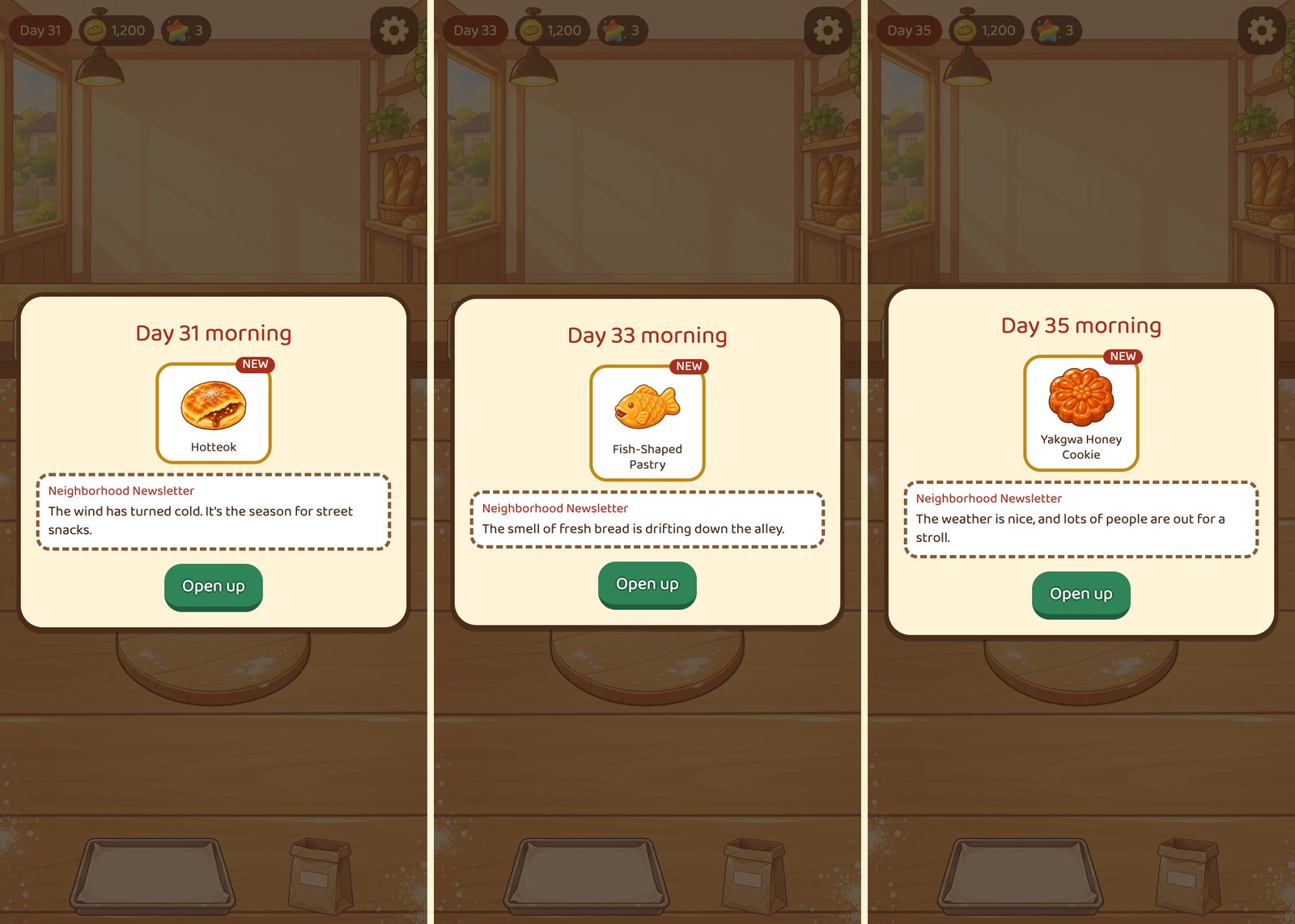
Chichi's Baking: Cooking Games is a first-person bakery game where you make the bread a customer asks for by picking three slots: dough, filling and topping. From Day 31 the game runs seasonal bread weeks, so Hotteok unlocks as a new bread on Day 31, Fish-Shaped Pastry on Day 33 and Yakgwa Honey Cookie on Day 35.
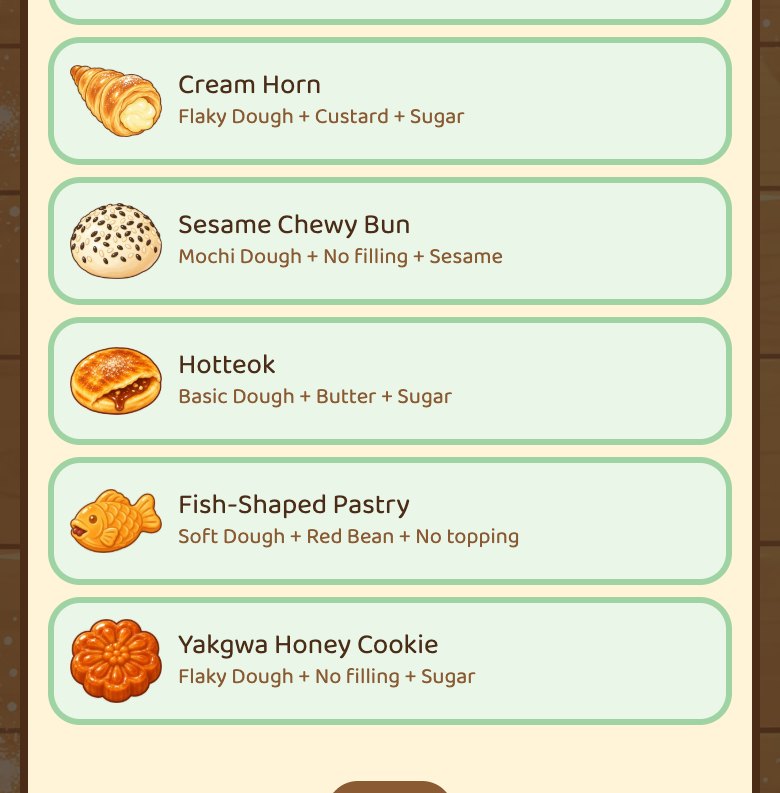
Here are the in-game recipes. Hotteok is Basic Dough with a Butter filling and Sugar on top, Fish-Shaped Pastry is Soft Dough with a Red Bean filling, and Yakgwa Honey Cookie is Flaky Dough with Sugar. Unlike the dictionary, the game puts every warm snack a customer might order at a bakery into the Bread Notebook. On Day 37, the day of the first snow, orders for Hotteok and Fish-Shaped Pastry are weighted three times heavier and come pouring in.
Bungeoppang vs taiyaki, hotteok vs pancake: what to call them in English
In English searches, the first questions about these snacks are comparisons like bungeoppang vs taiyaki or hotteok pancake. A single English word rarely gets them across, so giving the romanized name with a short description works better.
| Korean | Romanization | Plain-English description | In-game name |
|---|---|---|---|
| 호떡 | hotteok | yeast-dough pancake filled with brown sugar | Hotteok |
| 붕어빵 | bungeoppang | fish-shaped pastry filled with red bean paste | Fish-Shaped Pastry |
| 약과 | yakgwa | deep-fried honey cookie | Yakgwa Honey Cookie |
FAQ
Is bungeoppang bread?
The Basic Korean Dictionary includes fermentation in its definition of bread. Bungeoppang is an unfermented batter baked in a mold, a pulppang, so strictly speaking it is a pulppang that people call bread. The Encyclopedia of Korean Culture classes pulppang as a bread-type food.
Is hotteok a pancake, bread or a rice cake?
The name says tteok (rice cake), but the dough is wheat flour fermented with yeast. By the dictionary definition, hotteok is the closest to bread of the three, and in English it can be described as a pancake filled with brown sugar.
Is yakgwa a cookie or bread?
It is not bread. It is a yumilgwa made by kneading flour with honey and sesame oil, frying it and soaking it in honey, and it is classed as hangwa. In English it is sometimes described as a deep-fried honey cookie.
Are bungeoppang and taiyaki the same thing?
The mold and the shape come from the same line. Taiyaki is shaped like a sea bream, and in Korea it reportedly changed to a crucian carp (bungeo) shape. Batter thickness and how much filling goes in vary by shop, so it is hard to state a rule.
Is there a game with these snacks in it?
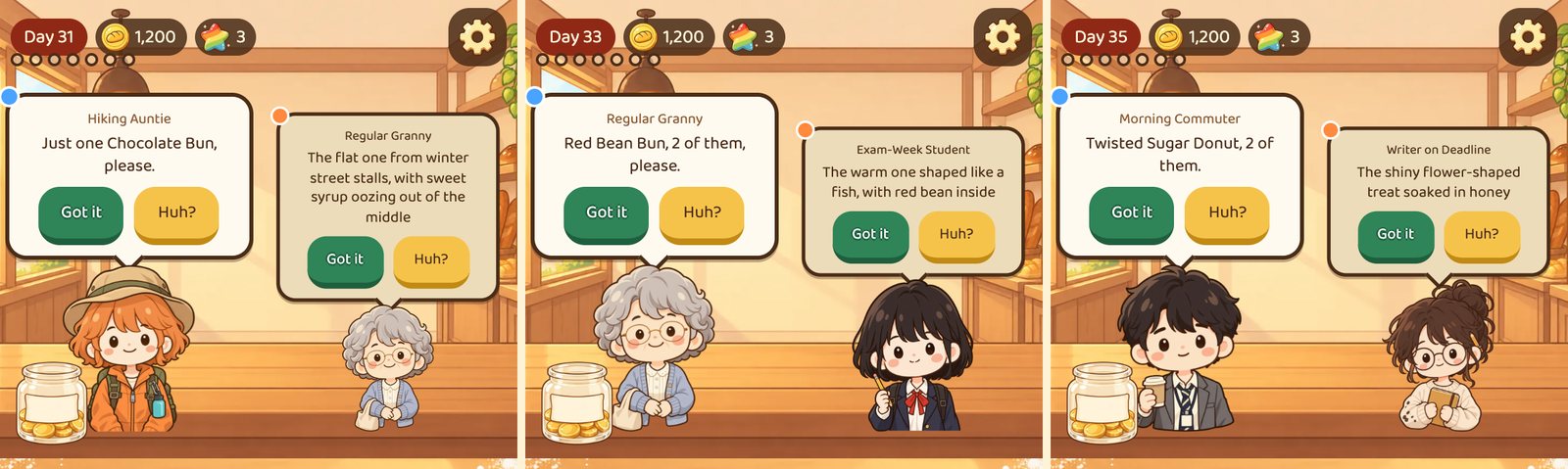
In Chichi's Baking: Cooking Games, which I made, Hotteok, Fish-Shaped Pastry and Yakgwa Honey Cookie unlock as new breads between Day 31 and Day 35. Customers describe them by how they look instead of naming them, and you pick the dough, filling and topping to make them.
Related
More from the blog
 ComparisonWe ran 9 Android ASMR games on a real phoneWe installed nine ASMR games on a Samsung Galaxy Z Flip5 and relaunched each in airplane mode. Install size, first screen and whether an ad blocks the game, checked on 20 November 2026.
 ComparisonOnsen and bathhouse games: 8 compared by what the store pages sayOnsen and bathhouse games from Steam, Google Play and the App Store in one table: price, rating, idle or not, Korean and Japanese support, plus the weak spots of our own game.
 ComparisonIdle tycoon games that work offline: 8 picks sorted by store labelsWhich idle tycoon games work offline? Google Play tag, store wording, list price and ads in one table, plus our own game's weak spots.
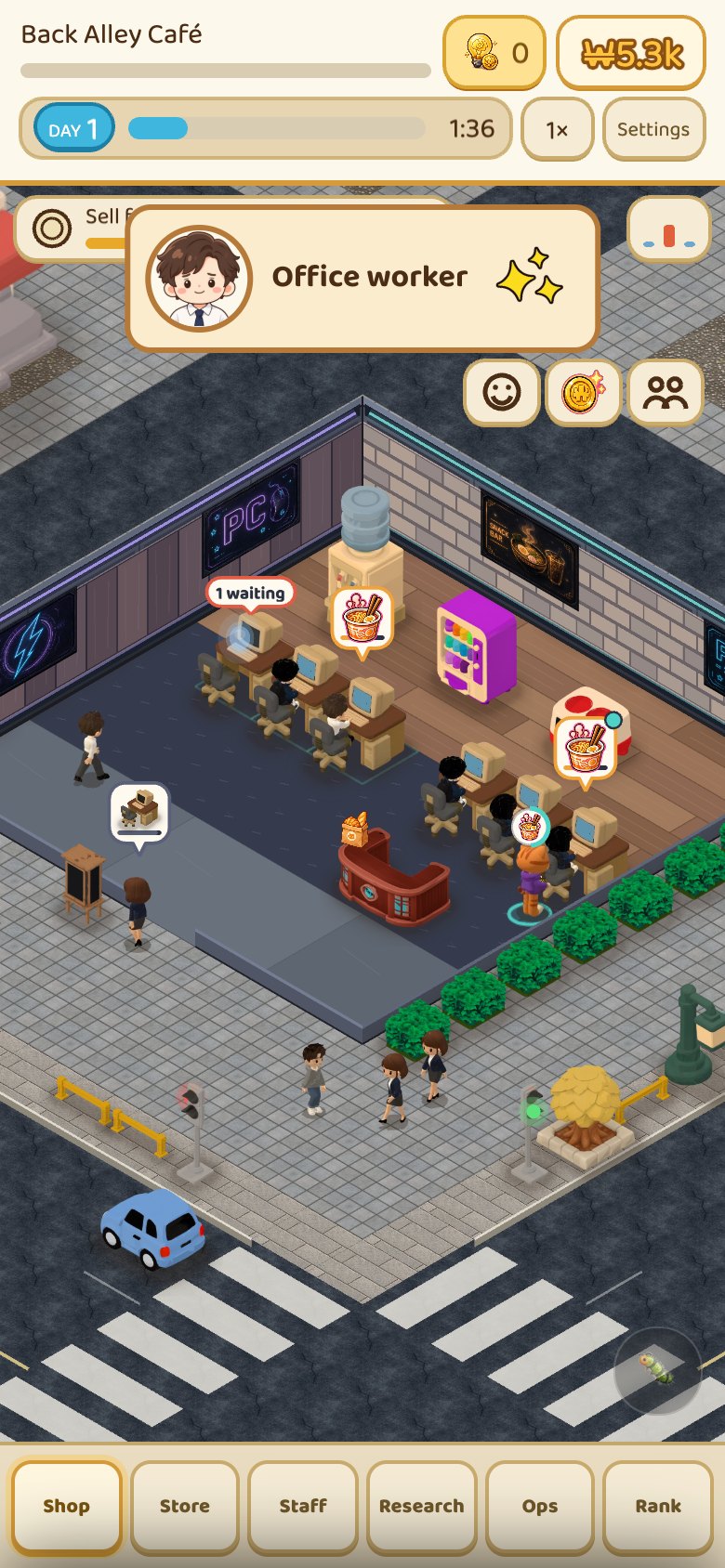 Games likeFinished Kairosoft? 14 games to play next, sorted by what you lovedIf you have played through Kairosoft, here are 14 games sorted into four flavors: short grow-it sessions, running a shop, watching residents live, and layout puzzles. Steam list prices, review scores and UI languages checked by hand.