Blog · Guide
Genre guide
What is a tycoon game? You are not collecting money, you are growing a shop
A tycoon game is a management simulation where you run a shop, a factory or a railway yourself and earn money from it. Tycoon means a powerful business figure in English, and English dictionaries trace the word to the Japanese taikun (大君). It became a game title after Railroad Tycoon in 1990. Roblox tycoons use the same word but play a little differently. This guide uses screens from our Internet Cafe Tycoon to show what one turn of the loop, earning money and growing the shop, looks like.
In one line
A tycoon game puts you in the owner's seat and asks you to grow a business. You open a shop, take customers, spend what you earn on equipment and move up to a bigger place. That one loop is the whole game. By genre it belongs to management simulation.
On the developer forum gamedev.net, one answer gives the most basic definition of a tycoon game as a game where the player's final goal is to make lots of money. Money, rather than combat or story, is the goal, and that is what sets the genre apart.
Where does the word tycoon come from?
Merriam-Webster traces tycoon to the Japanese taikun, written 大君, a title used for the shogun. It entered English in 1857, and according to English Wikipedia, President Lincoln's aides jokingly called him "the Tycoon". The word then spread to mean a powerful figure in business, which is the meaning it has today.
The Japanese Wikipedia entry on tycoon explains the game side. The word often appears in the titles of management simulations, mostly on PC, and people mistake it for a series name, but the pattern actually started with Sid Meier's Railroad Tycoon from MicroProse in 1990 and spread to games from other companies. So a word that left Japan came to mean a businessman in America, then came back as a game title.
The names you will see under the tycoon label
Quite different games sit under the same name. The Japanese Wikipedia list of games with tycoon in the title alone covers railways, theme park roller coasters, zoos, ski resorts, golf courses, shopping malls, airports and airlines.
What they share is a small start, whatever the subject. You begin with an empty lot or a single shop and widen it little by little with what you earn.
| Name | Subject | Source |
|---|---|---|
| Railroad Tycoon | A railway company | MicroProse, 1990 |
| RollerCoaster Tycoon | A theme park | Japanese Wikipedia list |
| Zoo Tycoon | A zoo | Japanese Wikipedia list |
| Transport Tycoon | A transport company | Japanese Wikipedia list |
| Internet Cafe Tycoon | A neighborhood PC cafe | Dumb Game Lab, mobile |
One turn of the loop, on screen
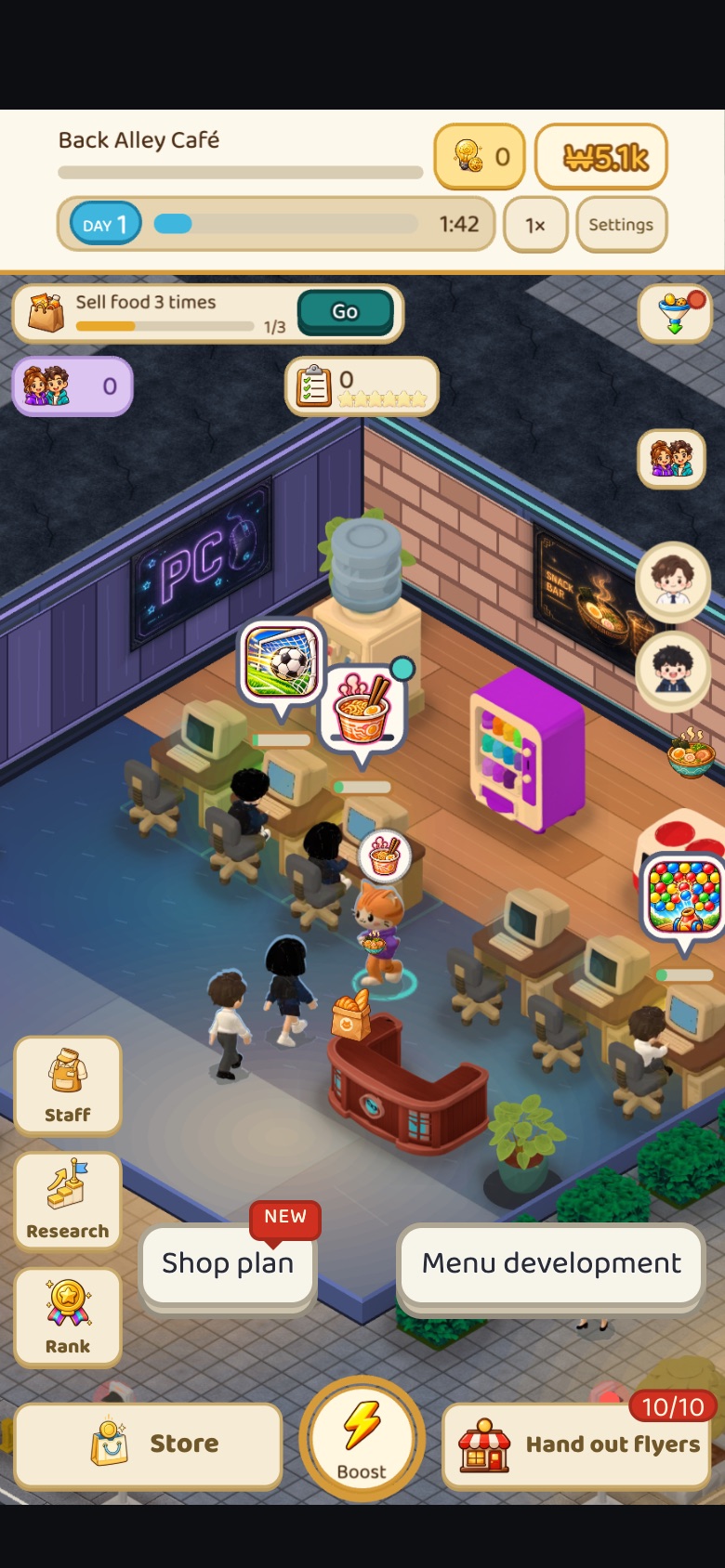
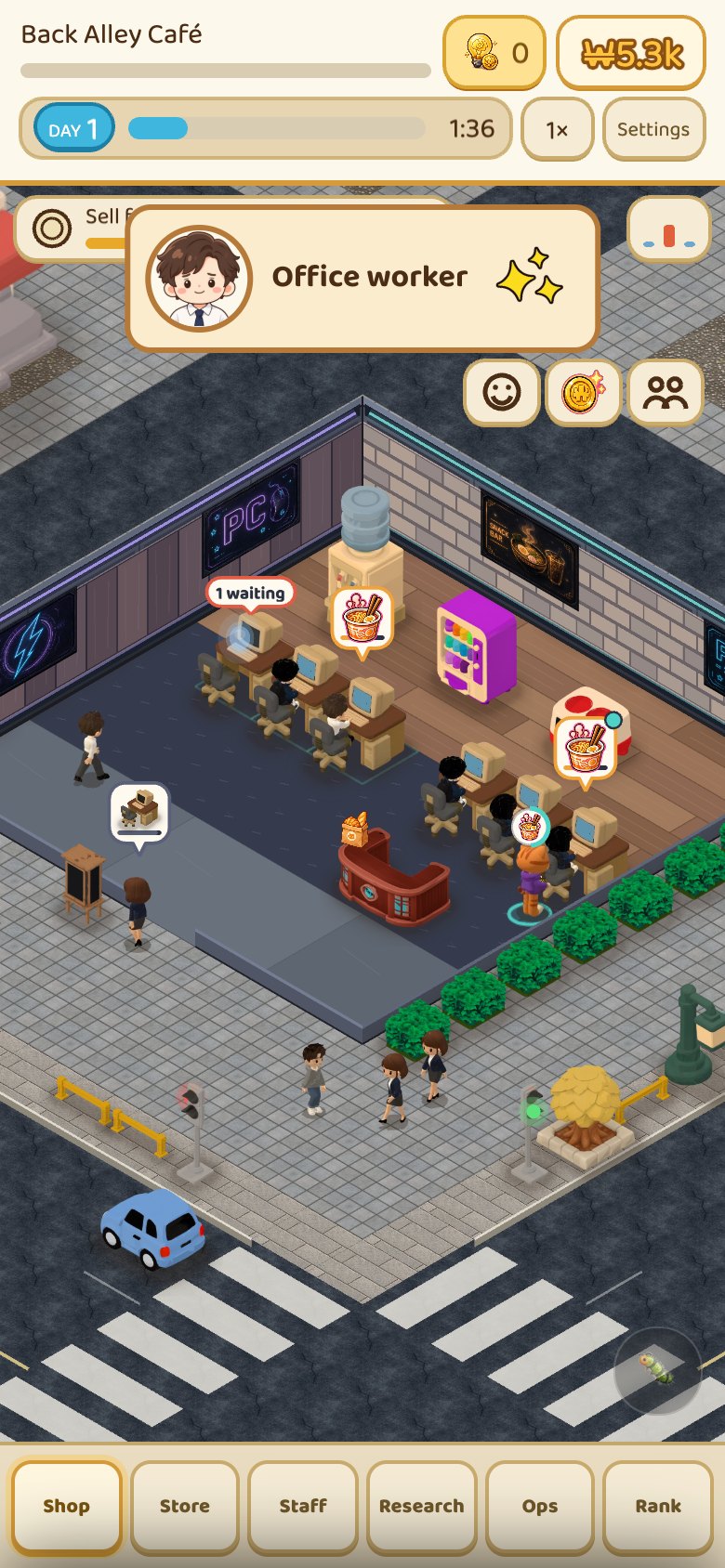
This is the first screen of our Internet Cafe Tycoon. Customers sit at worn PCs, and the cash you hold is at the top. The first goal is a single one, sell food 3 times, and finishing it opens the next. Small goals linked one after another are the flavor of a tycoon game.
One turn has three steps. The money customers spend comes in, you spend it on equipment, and more equipment seats more customers. Each time the loop turns, the shop visibly gets bigger.
Where does the money go?
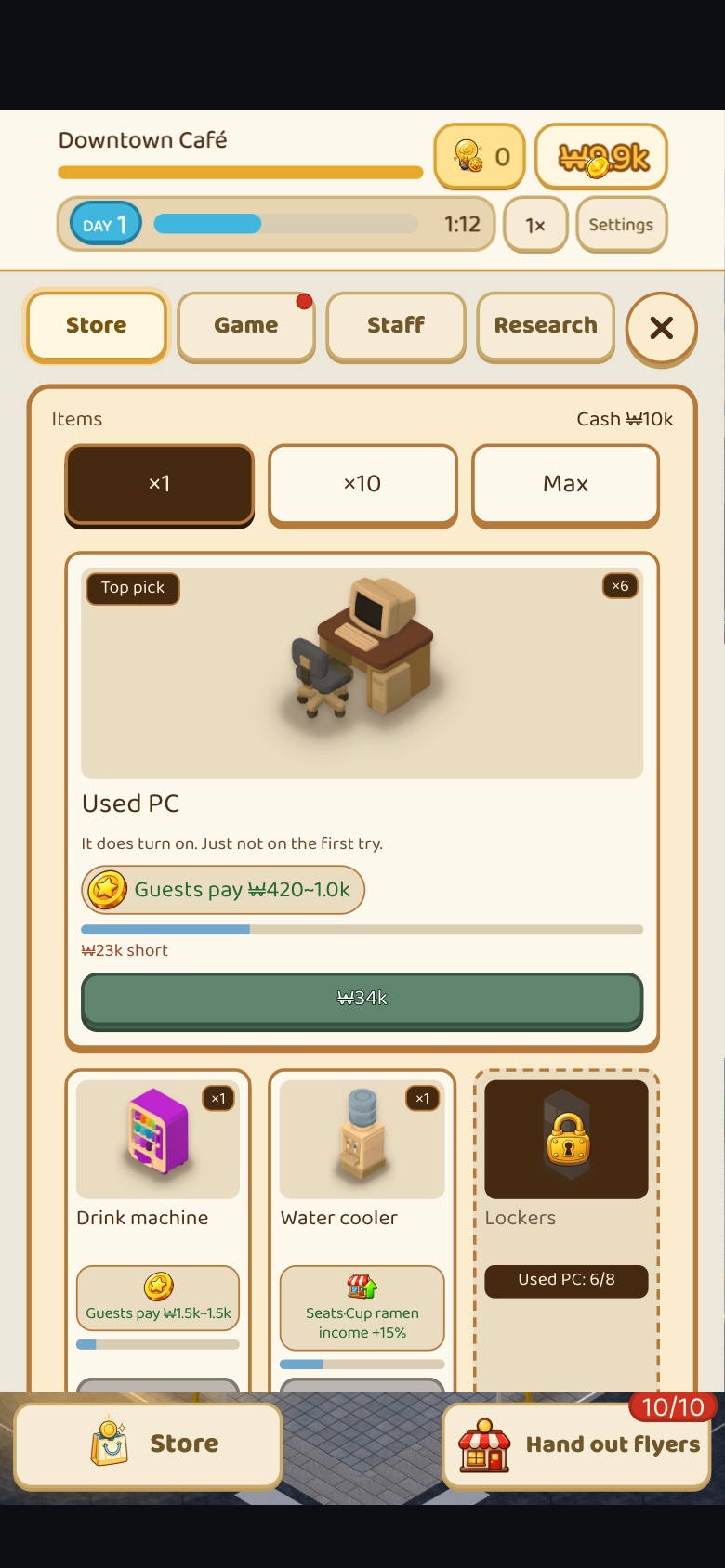
What makes a tycoon game fun is having several places to spend. On the store screen a used PC at about ₩34,000, a water purifier at about ₩39,000 and a drink machine at about ₩85,000 sit side by side. A PC brings in ₩420 to ₩1,020 per customer, the drink machine ₩1,500 per sale, and the water purifier raises the shop's income by 15%.
Deciding what to buy first is the management. Next to them is a locker that stays locked until you have 8 used PCs. You can see what has to happen before you can buy it, so the next move picks itself.
When the shop grows, the game changes
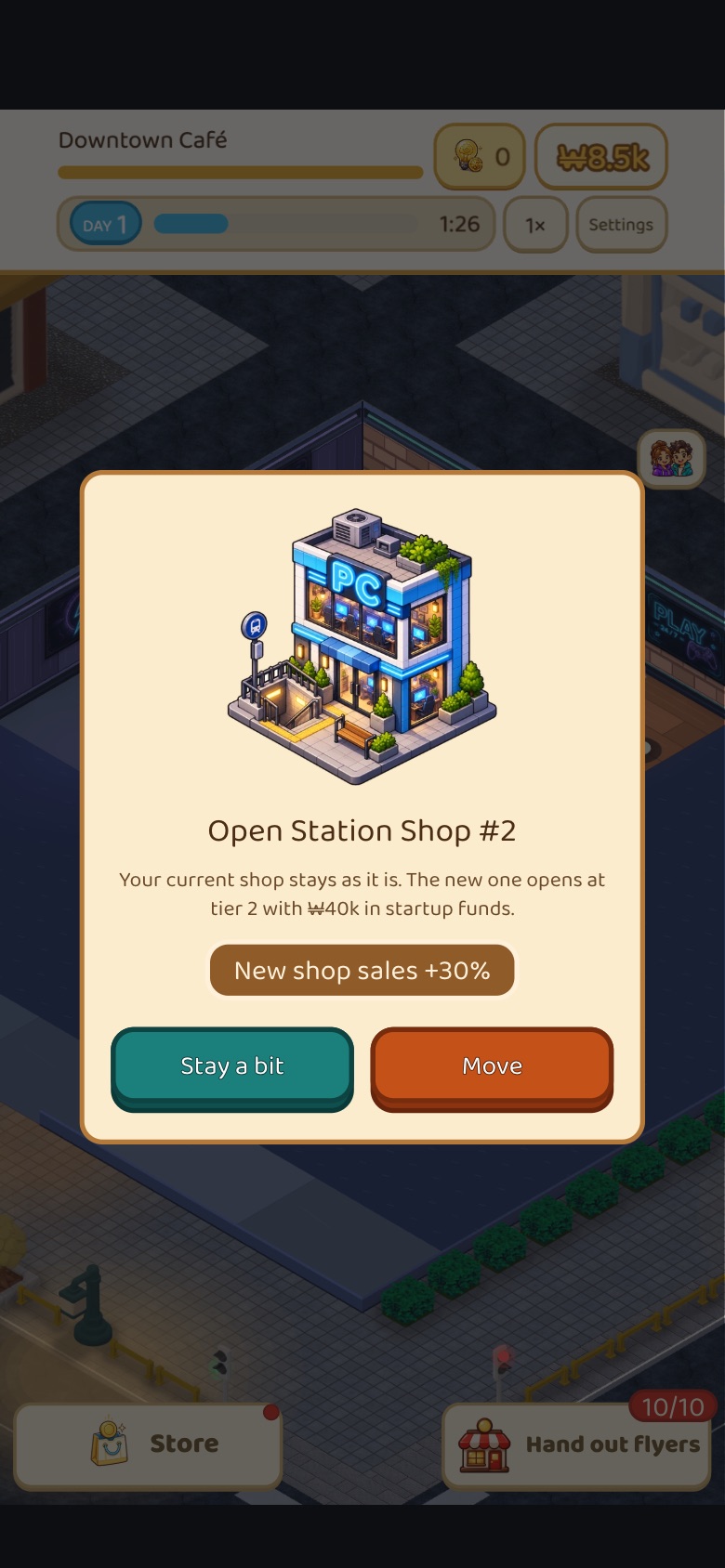
Keep growing a tycoon game and it changes shape. At stage 4 an Open Station Shop #2 window appears. Your current shop stays as it is, the new shop opens at tier 2 with ₩40,000 in start-up money, and its sales get a 30% boost.
Around stage 7 the same shop is packed with customers, coins burst out and achievement notices pop up. Watching the same shop turn into something completely different from where it started is why this genre lasts.
How are Roblox tycoons different?
Type tycoon into a search box and Roblox comes up with it. The Japanese Roblox glossary (roburo) describes a tycoon as a growth and management game where you collect in-game money or resources and add buildings and equipment. The skeleton is the same.
The difference is in how you play. In many Roblox tycoons your own character walks around and buys equipment, while a mobile tycoon like ours looks down on the whole shop and you decide the order of investment. Under the same name, one is played with the body and the other with the head.
Is it a different thing from an idle tycoon?
Yes. Idle describes how a game progresses, with income that keeps going while the app is closed, and tycoon describes the theme of growing a business. That is why many games are both. The idle side is covered in our idle tycoon guide.
How to pick a tycoon game
If this is your first one, check these three things and you are less likely to be disappointed.
- Is the subject a place you know? With something familiar like a neighborhood shop, what to buy comes to mind right away.
- Can you see one goal at a time? If the first screen does not show what to do next, interest fades fast.
- How long do you have to hold on? Match it to your day: a game you open and close in a minute, or one you sit down with for a long time.
FAQ
What does tycoon mean?
It is an English word for a powerful figure in business. Merriam-Webster traces it to the Japanese taikun (大君).
What is a tycoon game?
A management simulation where you grow a business such as a shop or a factory and earn money. The core is the loop of buying equipment with what you earn and widening the shop.
Where did tycoon games start?
Japanese Wikipedia says the pattern started with Railroad Tycoon from MicroProse in 1990 and spread to other companies.
Are Roblox tycoons the same genre?
The skeleton is the same: you collect money and add buildings and equipment. The difference is that many of them have you move your character and step on buttons.
More from the blog
 ComparisonOnsen and bathhouse games: 8 compared by what the store pages sayOnsen and bathhouse games from Steam, Google Play and the App Store in one table: price, rating, idle or not, Korean and Japanese support, plus the weak spots of our own game.
 ComparisonIdle tycoon games that work offline: 8 picks sorted by store labelsWhich idle tycoon games work offline? Google Play tag, store wording, list price and ads in one table, plus our own game's weak spots.
 Games likeFinished Kairosoft? 14 games to play next, sorted by what you lovedIf you have played through Kairosoft, here are 14 games sorted into four flavors: short grow-it sessions, running a shop, watching residents live, and layout puzzles. Steam list prices, review scores and UI languages checked by hand.
 ComparisonInternet Cafe Simulator Games in 2026: 17 Picks, iPhone IncludedLooking for an internet cafe simulator on iPhone, Android or Steam? We compared 17 games using prices, ratings and offline notes read straight off the store pages, plus our own game's weak spots.