
Blog · Korean culture
Korean culture, the bathhouse snack counter
Korean sauna eggs and sikhye: what a jjimjilbang actually sells
This is not a recipe, because search results for Korean sauna eggs and sikhye are almost all home recipes. It is a fact check of what a jjimjilbang (a Korean bathhouse and sauna complex) sells at its snack counter. The eggs are cooked for a long time until the outside turns brown, and are also called maekbanseok eggs. Sikhye is a sweet drink made by letting rice break down in malt water, and ordinary sikhye has no yeast, so it does not turn into alcohol. Prices vary by place, but 3 eggs in the 2,000 to 3,000 won range and a cup of sikhye in the 3,000 to 5,000 won range are common. Do not crack an egg on your forehead, which can hurt or bruise. Tap it on the floor or a table and peel it by hand.
What are jjimjilbang eggs and sikhye
The most common order at a jjimjilbang snack counter is a few roasted eggs and a cup of sikhye. After sweating in the saunas, people sit down and eat them as a snack.
In Korean the eggs go by several names: maekbanseok gyeran (맥반석계란), gu-un gyeran (구운계란) and gu-un ran (구운란), and some counters write hunje gyeran (훈제계란), smoked egg. Sikhye is a sweet drink made by letting cooked rice break down in malt water. Japanese renders it as シッケ and Traditional Chinese as 甜米露.
How are Korean sauna eggs different from boiled eggs
A boiled egg is cooked in water, while a roasted egg is heated for a long time and loses moisture. That turns the white brown and makes it chewier. English-language cooking blogs explain the browning as the Maillard reaction and say eggs made the same way at home come out a similar color.
By looks they come in three kinds: a roasted egg in a normal shell, a smoked egg with a brown shell, and a charcoal egg with a black shell. The English-language travel site Creatrip describes them this way.
| Kind | Looks | Note |
|---|---|---|
| Roasted egg | Normal shell, brown white | The egg most people picture at a jjimjilbang counter |
| Smoked egg | Brown shell | Some shops use it as another word for maekbanseok eggs |
| Charcoal egg | Black shell | The third kind Creatrip describes |
| Boiled egg | White shell, white white | Cooked in water |
Are maekbanseok eggs really roasted on stone
The name contains maekbanseok, a mineral stone, but not every egg is cooked on stone. A write-up of a 2011 MBC investigative show quotes a manufacturer saying only some factories roast eggs on maekbanseok and most use electric heat without it. That is a 15-year-old summary, so we cannot say it holds for every place today.
We found no public information on what machine a jjimjilbang counter uses. All we know is the food category: Korea's food safety ministry (MFDS) regulates roasted eggs as processed egg products.
Do not crack the egg on your forehead
Korean variety shows and dramas often show someone cracking an egg on their forehead. We found no solid explanation of where the habit started, only a personal answer saying TV made it stick. Treat it as folklore.
A roasted egg has a hard shell. A Japanese site of Korean-language guides and Creatrip both warn that cracking one on your forehead can hurt or bruise. Tap it on the floor or a table to make a crack, then peel it by hand.
Is sikhye alcoholic
The Encyclopedia of Korean Culture describes sikhye as made by pouring malt water over cooked rice and keeping it at 60 to 70 degrees for 4 to 5 hours. The enzymes in the malt turn the starch in the rice into sugar. To become alcohol you need yeast that eats sugar, and malt has no yeast, so ordinary sikhye stops at being a sweet drink.
Some things with similar names are different. Gamju and dansul are used for the same drink in some regions, and there are alcoholic variations such as yeonyeop sikhye, which uses sake with lotus leaf. Andong sikhye is a separate drink with radish and chili powder that is fermented without boiling. Makgeolli is fermented with nuruk and has roughly 5 to 8 percent alcohol, so it is not the same as sikhye.
| Name | How it is made | Alcohol |
|---|---|---|
| Sikhye | Malt enzymes break down rice, then it is boiled to finish | Generally none |
| Andong sikhye | Radish and chili powder, fermented without boiling | No official figure found |
| Yeonyeop sikhye | A variation with glutinous rice, sake and honey in a lotus leaf | Yes (uses sake) |
| Makgeolli | Alcoholic fermentation with nuruk | Around 5 to 8 percent |
How many calories are in a can of sikhye
For canned sikhye, the product label is the standard. Paldo's Bilak Sikhye (비락식혜) 238 ml can lists 90 kcal, 22 g carbohydrate and 19 g sugars on the official Paldo site. A shop selling the same product lists 85 kcal and 17 g sugars, so figures vary by period and volume, and checking the label before you buy is the accurate way.
Sikhye boiled on site at a jjimjilbang has no label. All you can say is that it is a sweetened drink. A Japanese guide site advises that drinking cold sikhye all at once right after sweating can shock the stomach, so drink water alongside it.
Is sikhye halal
The question "is sikhye halal" comes up often in Indonesian and Vietnamese searches, and it shows up in English autocomplete too. The usual explanation is that it is a drink that does not turn into alcohol, but halal status is decided product by product through certification.
We confirmed one fact. Food trade press reported that in 2023 Paldo received halal certification from Indonesia's halal authority (BPJPH) for 5 beverages including Bilak Sikhye, and began exporting to Indonesia in February 2024. We could not confirm whether other brands, or sikhye boiled on site at a jjimjilbang counter, are certified, so for those the only way is to ask.
How much do they cost
Prices differ from one jjimjilbang to the next, so there is no single number. Here are the two sources we confirmed, in Korean won.
| Source | Roasted eggs | Sikhye |
|---|---|---|
| A July 2026 visit review of a jjimjilbang in Cheongdo, Gyeongbuk | 2,000 won for 3 | 4,000 won |
| Summary of 12 answers on a Q&A site, May 2024 | 2,000 to 3,500 won for 3 | 3,000 to 5,000 won |
Why are eggs and sikhye a pair
We found no certain origin. One explanation says the boiled eggs and drinks sold at neighborhood bathhouses carried over into the roasted eggs and sikhye of the jjimjilbang. There are accounts that sweet sikhye washes down salty eggs, and a Taiwanese immigration agency guide says they are good for refilling fluids and nutrients after sweating, but no scientific basis is given.
So this article says only "it has been eaten this way for a long time." A pairing that cannot be pinned on one reason has simply lasted.
How it works in our game
In Korean Spa Tycoon by Dumb Game Lab, the kiosk and the Sikhye Machine are separate facilities. You cannot place both from the start. The kiosk opens at 20 total guests, and the Sikhye Machine opens when you own two kiosks. You sell eggs before you can sell sikhye.
The prices differ too. A kiosk costs 1,500 won to place and a Sikhye Machine 4,000 won, and each use brings in 150 to 400 won at a kiosk and 300 to 700 won at a Sikhye Machine. These amounts are in-game money, not real jjimjilbang prices. A Sikhye Machine next to a Kiln Sauna sells 1.2 times as much, next to a Salt Room 1.15 times, and next to an Ice Room 1.1 times. A kiosk next to a Kiln Sauna also sells 1.2 times. We turned the real-life order of buying something right after sweating into a rule.
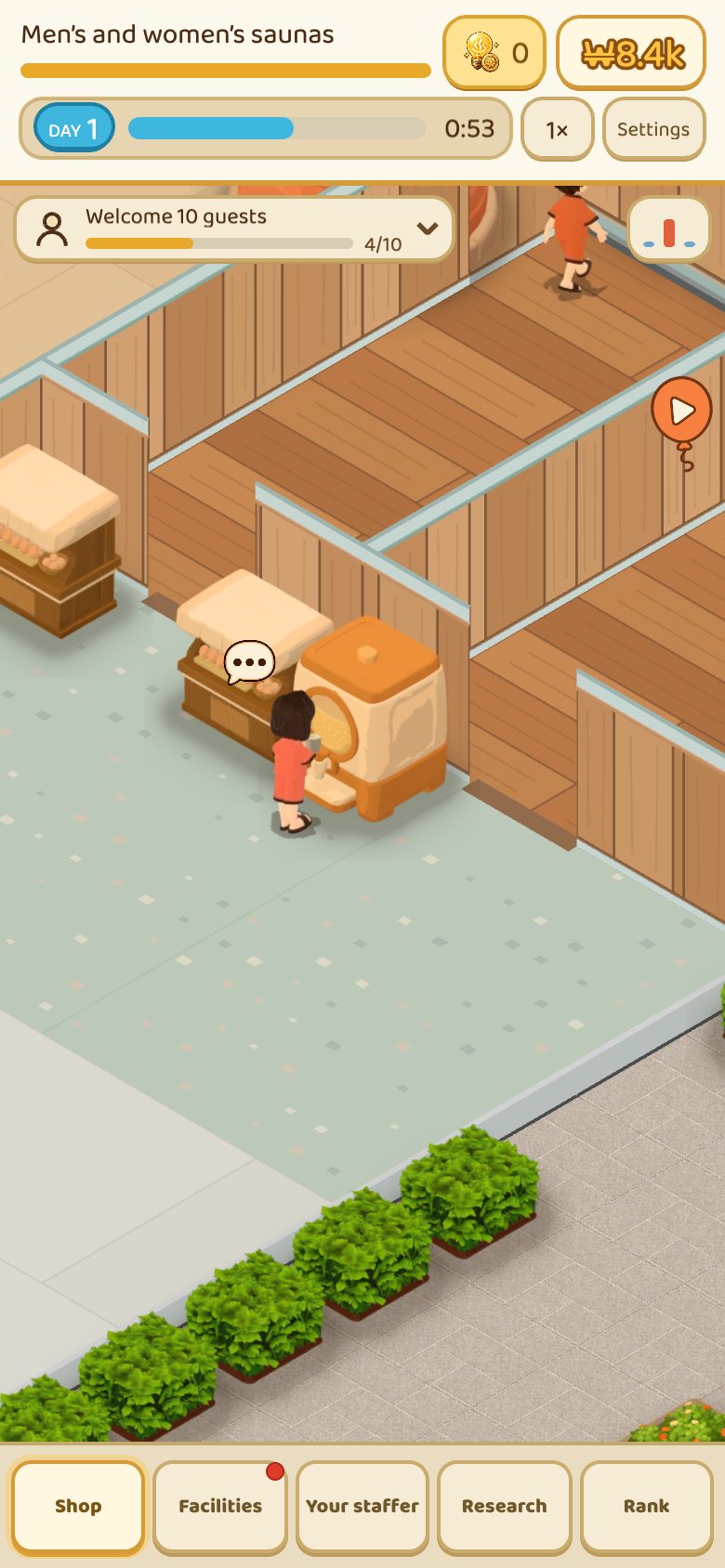
Of the 13 guest routes, three include the kiosk, and only one includes sikhye: the route of a guest who goes through the cold bath and leaves the Kiln Sauna. The screen below shows a guest paying at the Sikhye Machine.
There is a research item called Roasted Egg Secret
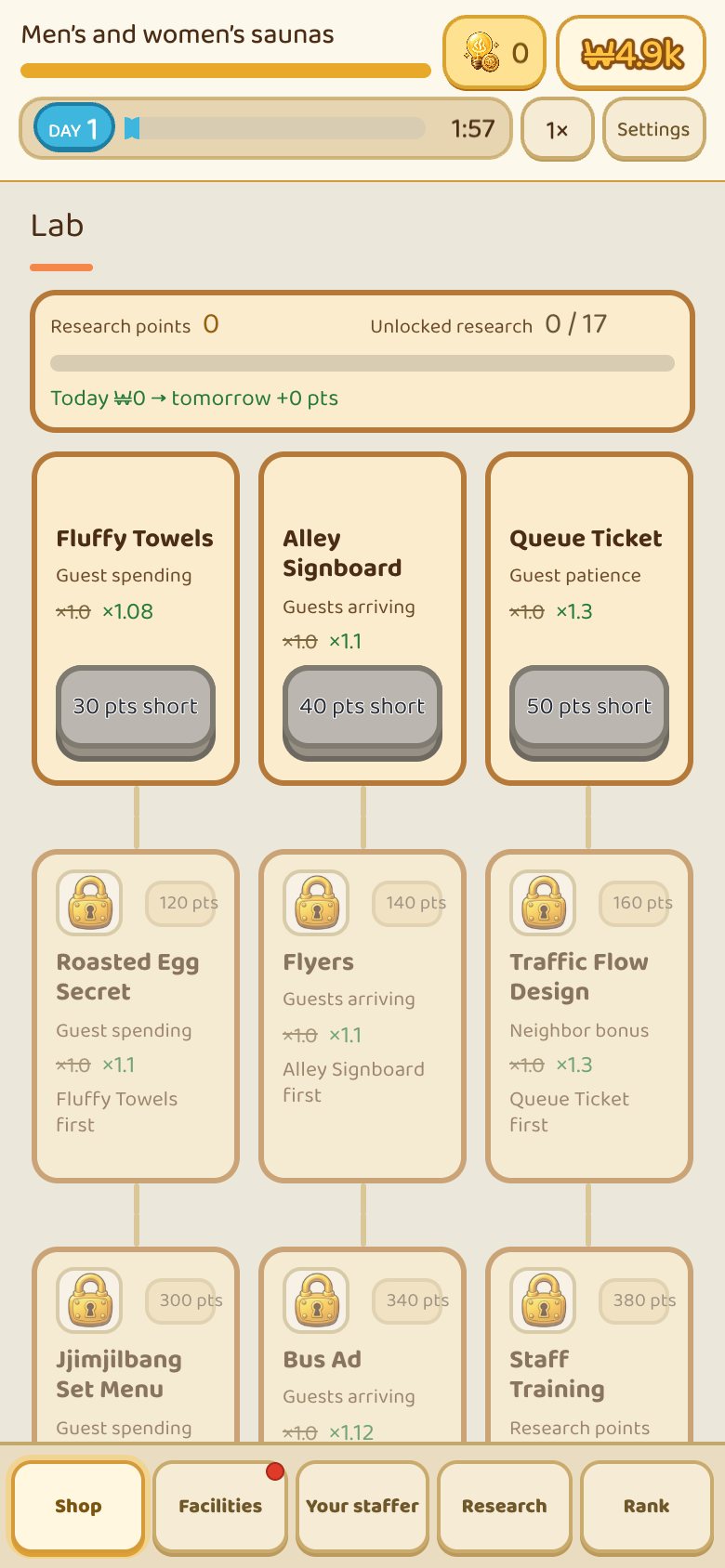
The Lab has an item named Roasted Egg Secret. It opens from Stage 2 and costs 120 points, and you must research Fluffy Towels first. Its effect is 1.1 times guest spending, and its description reads "Snack stand sells one more." After it comes the Jjimjilbang Set Menu (300 points, Stage 3).
The daily bonus list also has Egg Service. Its effect is that guests spend a bit more tomorrow.
Where our game falls short
Korean Spa Tycoon is new, so it has few installs and almost no ratings yet. The eggs in the game only get peeled, and no one cracks one on their forehead. Sikhye is just a cup coming out of a machine, so the taste and nutrition details above are not something the game teaches.
In-game prices and multipliers are values set to balance the game. They do not reflect the real cost or profit of a jjimjilbang.
FAQ
Are Korean sauna eggs the same as boiled eggs?
No. A roasted egg is heated for a long time, loses moisture, turns brown in the white and is chewier. Korea's food safety ministry classifies roasted eggs as processed egg products.
Are maekbanseok eggs really roasted on stone?
Only some. A write-up of a 2011 TV report says most factories roast without maekbanseok, using electric heat. We found no public information on how jjimjilbang counters cook them.
Is sikhye alcoholic?
Ordinary sikhye is not. Malt has no yeast to make alcohol, so the rice only breaks down into sugar. Variations such as yeonyeop sikhye, and makgeolli, do contain alcohol.
Is jjimjilbang sikhye halal?
It depends on the product and the counter. The one confirmed fact is that Paldo's Bilak Sikhye received Indonesian halal authority certification in 2023. We could not confirm sikhye boiled on site.
How much do jjimjilbang eggs cost?
It depends on the place, and they are usually sold in 3s. The sources we found run from 2,000 won to 3,500 won for 3. Sikhye is commonly 3,000 to 5,000 won.
More from the blog
 ComparisonOnsen and bathhouse games: 8 compared by what the store pages sayOnsen and bathhouse games from Steam, Google Play and the App Store in one table: price, rating, idle or not, Korean and Japanese support, plus the weak spots of our own game.
 ComparisonIdle tycoon games that work offline: 8 picks sorted by store labelsWhich idle tycoon games work offline? Google Play tag, store wording, list price and ads in one table, plus our own game's weak spots.
 Games likeFinished Kairosoft? 14 games to play next, sorted by what you lovedIf you have played through Kairosoft, here are 14 games sorted into four flavors: short grow-it sessions, running a shop, watching residents live, and layout puzzles. Steam list prices, review scores and UI languages checked by hand.
 Games likeGames like Game Dev Story: 7 Kairosoft alternatives worth playing nextGames like Game Dev Story and Kairosoft alternatives on Steam, iOS and Android, with price, ratings and language support in one table.